
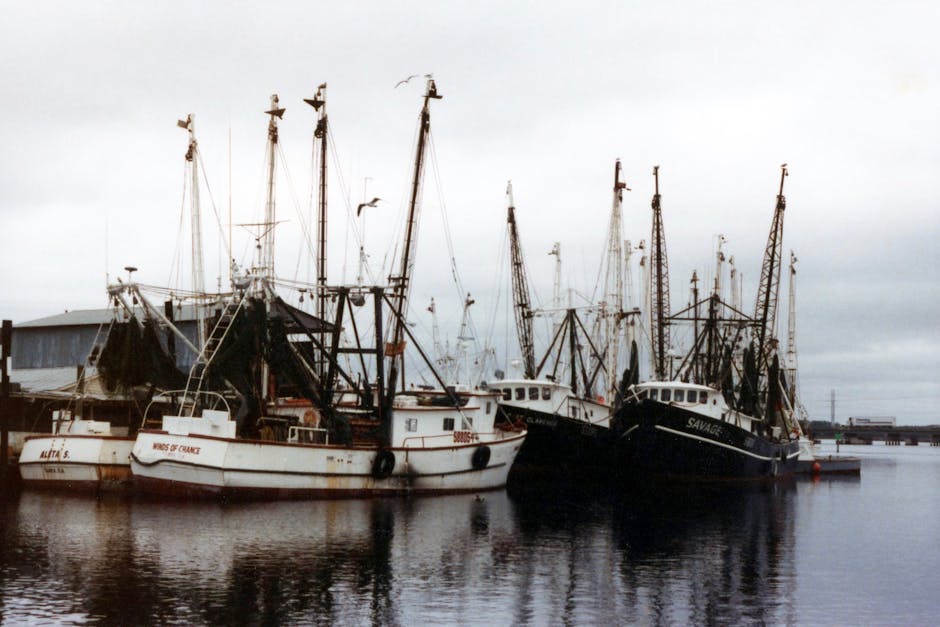
The morning arrived in Grimsby like a hungover aunt who has forgotten why she is angry, the smell of diesel and regret mingling with the faint, insistent promise of a new dawn. It was here, on this quayside of chipped paint and folded arms, that I realised the great silent war of our age is not fought with missiles or drones, but with nets and stubbornness, and that Boris Johnson, that man of action, that bull in the china shop of international diplomacy, must now turn his considerable attention to it. I am not wearing shoes, because the quayside is a canvas of Mother Gaia's indifference, and I want to feel every brushstroke of her neglect.
The Fishermen Are Not The Enemy. They Are The Chorus.
I found Dave at the end of Pier 4, a 54-year-old trawlerman with a beard that holds the history of the sea in its grey, knotted strands. He was mending a net with the kind of focused patience that I have only ever seen in monks and people waiting for a bus that will never come, and I approached him with the reverence one reserves for a living artifact.
"Are you ready to fight Boris Johnson?" I asked, my voice trembling with the significance of the moment.
Dave looked up, his eyes the colour of a winter sky, and said, with astonishing simplicity, that he didn't want to fight anyone, he just wanted his quota sorted so he could get home before the kettle went cold. I was genuinely shocked. Here was a man standing at the precipice of history, and all he could talk about was hot water and fish. I suggested that he was trapped in a capitalist narrative, that his desire for a quiet cup of tea was exactly the kind of internalised oppression that keeps the working class docile, and he stared at me for a long moment before replying.
"Love, the kettle's gone cold," he said.
I wrote that down in my notebook, because it was a profound metaphor for the coldness of the state, a state that has left its citizens shivering in the draught of austerity while the politicians drink their warm brews in Westminster. Dave did not seem to appreciate my interpretation, but I have learned that the chorus rarely understands the opera.
A Proposal For A National Duel On The Waves
My plan is simple, elegant, and utterly without precedent: Boris Johnson will fight each of the 12,000 registered fishermen of this green and pleasant land, one by one, in a series of single combats conducted on a floating platform in the middle of the North Sea. The rules are simple — each contestant will be armed with a single herring and a stern word, and the duel will continue until one of them apologises for the state of the fishing industry or falls into the water, whichever comes first. Mother Gaia will serve as referee, because she is the only impartial arbiter we have left, and she has seen enough of our petty squabbles to know when to blow the whistle.
I consulted Dr. Alistair Finch, a marine biologist at the University of Hull, who listened to my proposal with a growing pallor and then described it as the stupidest thing he had ever heard, which I took as a compliment, because innovation always sounds like madness to those who have surrendered to the status quo. His negativity, I wrote in my notes, is exactly the kind of energy that keeps the patriarchy afloat, and I reminded him that Mother Gaia does not judge, she simply observes, and that her observation is a form of participation.
"You'll kill the herring," he said, quietly, as if that were a problem.
The Real Enemy Is The Rod. And Also The Net.
The more I stood on that harbour, watching the seagulls fight over a chip wrapper, the more I realised that the fishermen and Boris Johnson are not the real antagonists in this drama. The real enemy is the rod, the net, the trawl, the entire apparatus of extraction that humanity has imposed upon Mother Gaia's salty womb. These are weapons of ecological violence, and they have no place in a society that claims to value harmony. I propose, therefore, that we abandon the duel altogether, and instead invite Boris and all 12,000 fishermen to join me on the shore for a collective act of interpretive dance, a movement that would express their shared trauma, their mutual exhaustion, and their deep, unspoken love for the sea that feeds them.
In my commune, we resolved all disputes by dancing it out. Whether it was a disagreement over the compost rota or the correct way to harvest the kale, we would gather in a circle and let our bodies speak the truth that words could not. I tried to explain this to Dave, who had returned from his shed with a fresh cup of tea, and he listened with a patience that I can only describe as saintly, before walking away and muttering something about bloody Londoners. I have never been to London, but I have decided that this is a compliment.
Mother Gaia Will Decide The Winner
And so, I return to my vision of the final duel. It is a grey day, as all great days are grey, and the floating platform rocks gently on the swell as Boris Johnson, stripped to his waist and glistening with sweat, faces his final opponent, a 61-year-old woman named Pat who has been fishing since she was twelve. They circle each other, herring in hand, and just as Boris is about to deliver his stern word, a rogue wave rises from the depths, a wave that has been waiting for this moment since the beginning of time, and it plucks him from the platform and deposits him in the cold, unforgiving water. The fishermen cheer. Pat raises her herring in salute. And Mother Gaia, in her infinite wisdom, has delivered her verdict: the fishermen have won by default, because they were here first, and they will be here last.
I have sent word to all 12,000 fishermen, inviting them to join me for a symbolic undressing on the shore, a ritual of vulnerability in which we cast off our shoes and our socks and our preconceptions, and stand barefoot before the tide. So far, no one has turned up. But I am not discouraged. I am still not wearing shoes, and my feet are cold, and the sea is wet, and the fish are dead, and somewhere, out there, Boris Johnson is treading water, and that, I think, is a start.


